Showing posts with label twentieth century. Show all posts

Saturday, 20 August 2016

The History Of GMC

The Rapid Motor Vehicle Company was founded in Pontiac, Michigan, in 1902 by the famous Grabowsky Brothers. It was formed after the brothers had introduced their famous one-ton truck in 1900 and was quite successful till 1911, when General Motors (GM) acquired Reliance and Rapid Company and merged them both to form the GMC Division of General Motors.
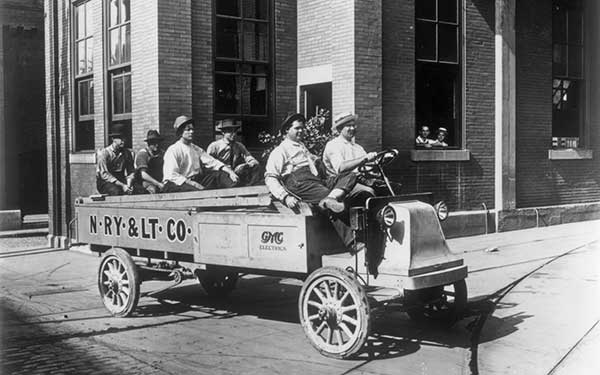
It is said that the first GMC logo appeared way back in 1912 at the New York Auto Show. At that time, the trucks were Rapid and Reliance manufactured with the GMC brand logo applied. However, by 1913, all the trucks introduced by the company were advertised as GMC. In this article, you will learn how the company started and where it is today along with important events, interesting news, and list of all current trucks and SUVs.In 1915, a total of 760 GMC cars were built, with capacities ranging from 3/4th to 2-tons and by 1916 more new models were released with capacities up to 5-tons. By 1917, GMC had built a total 509 electric trucks and the company had also provided the US Army over 8,500 trucks for World War I. Most of these were light aviation support trucks and 3/4-ton ambulances.

In 1920, the GMC brand incorporated the use of pneumatic tires on light GMC trucks, replacing the traditional solid rubber tires. A year later, the new K-Model trucks were debuted that featured the famous Northway Engines. Additionally, dual-range 7-speed transmissions and electric lamps were available as standard equipment on all GMC trucks.
In 1925, the Yellow Cab Manufacturing Corporation merged with GMC and brakes on rear-wheels were replaced by 4-wheel brakes. In 1930, the heaviest GMC models were introduced with tandem driving rear axles and within a year, GMC took over production of Buick’s 6-Cylinder engines, used metal sheets on its trucks’ front ends and two extra heavy duty vehicles were introduced.

By 1937, the company had redesigned 23 of their vehicle models that featured the latest 2-color scheme and new streamline styling. A few years later, the production of three new small block engines began and diesel engines were released for the heaviest GMC models.In 1941, due to the impending war, GMC built nearly 530,000 trucks for the US army. Most of these trucks were powered by the latest GMC 270 CID Engine. By 1945, GMC had produced nearly 584,000 multi-drive vehicles for the war. The same year, government restrictions on producing civilian trucks were lifted and GMC returned to manufacturing new and stylish passenger trucks.

In the 50s, GMC gained significant interest in manufacturing commercial vehicles and introduced two heavy-duty diesel tractor models and many medium duty cabs. Additionally, the company also provided over 9,000 military vehicles for the Korean War most of which featured deepwater fording ability, Hydra-Matic Transmissions, and GMC 302 CID Gas Engine.

A few years later, tubeless tires were made standard on all GMC trucks and power-steering was offered as an option on many models. By the end of the 50s, Hydra-Matics transmissions were replaced by Allison Torqmatic 6-Speed transmissions. In the 60s, most vehicles of the GMC brand were powered by new V12 and V6 gasoline engines.

And by 1965, the company replaced torsion bars with coil springs for the suspension and leaf springs returned for the rear. Alternators were also introduced and most of the GMC trucks featured new styling cues and designs that were never seen before. In 1969, E-Series trucks were also replaced by the new C-Series trucks with V6 gas or diesel engines.In 1970, the all-new Rallywagon and Vandura were introduced which replaced the Handibus and Handivan, disc front brakes became standard, and new sprint light pickups were announced. Therefore, by 1972 the company reached 4th place among the top light truck manufacturers in the US and by 1979, GMC was in 3rd place in overall truck sales in the US.

The 80s proved to be a successful period as well and the company managed to manufacturer many new trucks with great designs and exceptionally efficient and powerful engines that were in competition with Chevrolet and Cadillac Trucks. Mid of 1988, GMC then introduced the new Sierra full-size pickup trucks that featured vast improvements in all areas and cleaner styling.


In the 90s, GMC trucks made even more significant improvements in their trucks and introduced Electronic Fuel Injection (EFI) to replace traditional carburetors and throttle body injection systems, thus improving overall fuel efficiency of all GMC trucks. In 2012, the company celebrated its 100 years of existence and released a book with the complete timeline of the company.Now, GMC exists as one of the best and most famous truck manufacturers of the world and has been renamed from GMC Division of General Motors LLC to simply ‘General Motors Truck Corporation (GMC)’. It is the second-largest North American automaker in the truck division ahead of Pontiac but behind Chevrolet and also offers vehicle financing and insurance.If GMC was a stand-alone manufacturer, according to the amount of overall sales it would be the tenth-largest automaker in the US. Additionally, the GMC Sierra in 2011 outsold the famous Toyota Tundra and Nissan Titan with more than 40,000 sales.


The History Of Jeep

 Who doesn’t recognize the name of Jeep? It’s an iconic name that has not only been associated with adventurous rides, but for the sheer joy of riding one of the world’s best vehicles. The Jeep is popular by many names, like the Wagoneer, the Cherokee, the Rubicon, and of course, the Wrangler. However, regardless of the name, each Jeep is styled and designed in an exceptionally unique and distinctive way. Going back in the timeline, this automaker has been through numerous wars and many battles. Continue reading to learn more about the legendary history of Jeep.
The Jeep company started as a 4×4 utility vehicle which was used by armed forces in the Second World War, but after gaining a lot of success eventually the company shifted to creating public utility vehicles. However, there hasn’t been any clear evidence regarding when and who founded the Jeep.
And those who come up with explanations and stories have proven difficult to verify. Nevertheless, the origins of the Jeep can be traced back to when the Willy’s Trucks were introduced in 1941 and it is said that the name ‘Jeep’ was first advertised in 1947.

After the Second World War, in 1945 the famous Willy’s-Overland was converted into a CJ with the aim of putting farm workhorses out to pasture. This conversion resulted in the creation of the CJ-24 which was marketed as ‘The All-Around Farm Work-House’. Two years later, an early advertisement was introduced which had the word ‘Jeep Trucks’ in it.

Soon these two and four-wheel trucks became a hit in the market. These trucks could be fitted with a stake or pickup bed and used many components from the famous Willy’s Wagon. Therefore, they became popular by the name of Jeep. In 1948, the famous Jeep Jeepster was born, which was marketed as a sports car, but did lack performance.

By the end of the 40s, the CJ-3A was introduced, which is considered to be the father of recreational vehicles, featuring numerous refinements that had never been seen before. With the beginning of the new decade, the Jeep M38, a combat version of the CJ-3A was introduced. This vehicle became incredibly popular in the military. In 1955, the CJ-5 debuted and featured softer styling lines and rounded body contours. This vehicle was stronger, more off-road capable, versatile, and comfortable than most of its counterparts.
By the 1960s, Jeep became incredibly famous and synonymous with a variety of driving experiences, from fun and games to purely utility. It was during this time period that the company eventually started building vans as well. In 1962, the Wagoneer was also introduced with the Jeep Logo. A few years later, the J-series Trucks were introduced, the most famous being the J-3000 that featured Optional Vigilante V-8 and standard Jeep Hi-Torque 6.

The 70s was an incredibly successful decade for Jeep, as the first Cherokee was launched. This Jeep left such an impact that way into the second decade of the 21st century, people still think of the Cherokee as one of the ultimate Jeep designs. Additionally, by this time the brand was also recognized worldwide and also gained more prestige with numerous awards received for the efficiency of all their Jeep models.

From the launch of the famous Cherokee, within a decade almost six to seven different models of the vehicle were created and launched, thus creating even more exposure for the brand and taking its name countrywide and worldwide.
The 80s proved to the world that the previous Cherokee models were now even more improved with the new decade’s release. During this time period, the popular Cherokee XJ was launched that successfully managed to revolutionize the 4×4 market by introducing a series of ‘firsts’. For instance, the first full 4×4 system that came with the shift-on-the-fly, the construction of the first UniFrame, and the compact four-door SUV. However, in 1987, the Jeep Brand was acquired by Chrysler Automobiles along with the remaining assets of its owner, American Motors.

The 90s were great for the Jeep Wrangler, which is considered to be the ultimate escape machine. It was and still is considered to be the perfect getaway vehicle and even in 1997 offered exceptional on-road handling and legendary off-road capability. Not to mention, the vehicle won the prestigious ‘4×4 of the Year’ award in 1997.

The vehicle became incredibly popular because almost 80% of its parts were newly designed and it came equipped with the latest and newest Quadra-Coil suspension, which provided a greatly improved on-road ride and replaced the traditional leaf-springs. Moving forward to the 00s, numerous new models were introduced. Some of the best included the Jeep Rubicon, Liberty, Patriot, Compass, and Commander. Most of these Jeep Cars boosted the sales throughout the new century for Jeep and still hold a strong position in the automobile market.Now, Jeep Automobiles exists as one of the best truck and SUV manufacturers in the US. It sells its vehicles in around 140 countries. However, just last year the company was taken over by Fiat Chrysler Automobiles (FCA US LLC), but has successfully managed to introduce numerous new versions of its famous Wrangler, Cherokee, Compass, Patriot, and Renegade Jeep Series.

Before the ‘Jeep’ name originated, most of the trucks that were introduced at the start of the 40s were recognized as General Purpose (GP) vehicles. And most of these GP vehicles were manufactured by three companies: Bantom, Willy’s and Ford. Additionally, the ‘Jeep’ name is used as a common term for any 4×4 vehicle in several countries across the world. Not to mention, Jeep is considered the most popular brand among people who wish to modify their vehicles and get involved in DIY activities.
As you can see, the Jeep history has an incredibly interesting story to it. However, what’s even more interesting is: Driving one of its creations, especially the famous Wrangler! So, if you feel that your life lacks a little adventure, perhaps it’s time you test drive a Jeep. We hope you found all the information you were looking for about the Jeep logo, the timeline and the compilation of latest models.

Friday, 12 August 2016

Volkswagen - The history of peoples car

On may 28, 1937, the government of Germany–then under the control of Adolf Hitler of the National Socialist (Nazi) Party–forms a new state-owned automobile company, then known as Gesellschaft zur Vorbereitung des Deutschen Volkswagens mbH. Later that year, it was renamed simply Volkswagenwerk, or “The People’s Car Company.”

 Originally operated by the German Labour Front, a Nazi organisation, Volkswagen was headquartered in Wolfsburg, Germany. In addition to his ambitious campaign to build a network of autobahns and limited access highways across Germany, Hitler’s pet project was the development and mass production of an affordable yet still speedy vehicle that could sell for less than 1,000 Reich marks (about $140 at the time). To provide the design for this “people’s car,” Hitler called in the Austrian automotive engineer Ferdinand Porsche. In 1938, at a Nazi rally, the Fuhrer declared: “It is for the broad masses that this car has been built. Its purpose is to answer their transportation needs, and it is intended to give them joy.” However, soon after the KdF (Kraft-durch-Freude)-Wagen (“Strength-Through-Joy” car) was displayed for the first time at the Berlin Motor Show in 1939, World War II began, and Volkswagen halted production. After the war ended, with the factory in ruins, the Allies would make Volkswagen the focus of their attempts to resuscitate the German auto industry. 
Volkswagen sales in the United States were initially slower than in other parts of the world, due to the car’s historic Nazi connections as well as its small size and unusual rounded shape. In 1959, the advertising agency Doyle Dane Bernbach launched a landmark campaign, dubbing the car the “Beetle” and spinning its diminutive size as a distinct advantage to consumers. Over the next several years, VW became the top-selling auto import in the United States. In 1960, the German government sold 60 percent of Volkswagen’s stock to the public, effectively denationalising it. Twelve years later, the Beetle surpassed the longstanding worldwide production record of 15 million vehicles, set by Ford Motor Company’s legendary Model T between 1908 and 1927. 


 With the Beetle’s design relatively unchanged since 1935, sales grew sluggish in the early 1970's. VW bounced back with the introduction of sportier models such as the Rabbit and later, the Golf. In 1998, the company began selling the highly touted “New Beetle” while still continuing production of its predecessor. After nearly 70 years and more than 21 million units produced, the last original Beetle rolled off the line in Puebla, Mexico, on July 30, 2003.

Wednesday, 10 August 2016

the Motorcycle


The history of the motorcycle begins in the second half of the 19th century. Motorcycles are descended from the "safety bicycle," a bicycle with front and rear wheels of the same size and a pedal crank mechanism to drive the rear wheel. Despite some early landmarks in its development, the motorcycle lacks a rigid pedigree that can be traced back to a single idea or machine. Instead, the idea seems to have occurred to numerous engineers and inventors around Europe at around the same time.
Although the first person to put a motor on a bicycle must have seemed crazy at the time, the motorcycle has found an enduring space in the public imagination. Spanning three centuries of development and fascination, its beginnings were almost too humble to predict the monster machines that crowd the motorways today.
The very first, non-commercial vehicles that could be designated as motorcycles (almost) were mid-Victorian, and they of course used steam as their main source of propulsion. Like something out of a Jules Verne novel, inventors such as French bicycle manufacturer Ernest Michaux simply fitted a small steam engine to a ‘velocipede’ (basically any modern bicycle forerunner), and tooled around town burning their legs on hot steam and hotter dreams. Steam engines came in both the alcohol and coal-burning variety, and it’s frankly a mystery how anyone managed to stay atop one.
It wasn’t until the 1890s that what we know as the modern motorcycle was born. Coincidentally, this also heralded the invention of the first motorcycles available for public purchase. Gone were the steam-pumping of old; internal combustion now provided propulsion for the motorcycle. German engineers Hildebrand and Wolfmuller pipped American and British manufacturers – including the Excelsior Motor Company, Royal Enfield and Indian Motorcycle Manufacturing Company (US) – to the commercial post by introducing their eponymous internal combustion model in 1894, which was also the first model to be referred to as a ‘motorcycle’ (motorrad). But they only produced a couple thousand bikes in total and couldn’t keep up with their larger counterparts.
The First World War saw an increased interest in motorcycles for war communications, and at one point American manufacturer Harley-Davidson (founded 1903) had devoted 50 per cent of its output to the war effort. Messengers on motorcycles became a more familiar sight than those on horseback, and the British company Triumph, which had switched from bicycles to motorcycles in 1902, got in on the action with its 1915 Model H. Often considered the first ‘modern’ motorcycle, the Triumph Model H had no pedals and a reputation for reliability – essential in the midst of combat.
Harley-Davidson became the largest manufacturer of motorcycles in the world after World War 1, thanks in part to its wartime profits. Manufacture from all nations ramped up as peacetime citizens became even more interested in the machine, and the better the technology got, the faster the bikes went. By the Second World War, production motorcycle speeds were reaching 100 miles per hour, such as the unbelievably expensive Brough Superior – manufactured in Nottingham, England – which was a favourite of T.E. Lawrence (or Lawrence of Arabia). Lawrence ultimately died of injuries from a crash while riding his beloved Brough.
Another world war saw motorbikes in combat, and later gave rise to a new culture where motorbikes were used for recreation and to project a certain lifestyle. Motorcycles were being designed to cater to an image as well as a function, and they got bigger, meaner, louder and faster than ever before. In 1949 the Vincent Black Shadow, produced by the British Vincent Motorcycles as a sports-orientated model, gained (and held onto for 24 years) the land speed motorbike record of 125 miles per hour.

While American and European manufacturers dominated the modern motorcycle field for close to a century, the Japanese took a fair share of the market after the Second World War thanks to their low-cost, high-performance models. American and European firms suffered from talent drain and higher costs, and today Japanese manufacturers such as Kawasaki and Suzuki dominate the industry, despite many enthusiasts’ loyalty to more traditional brands.

Tuesday, 9 August 2016

History of Ship

Humans have tended to live near water, and it is natural to make use of things that float. Logs or bundles of reeds can be lashed together to form rafts; hollow trunks can be improved to become dugout canoes. Once the principle of a watertight hull is understood, animal hides or the bark of trees can be attached to a framework of bamboo or wicker to make a simple coracle.

Boats of all these kinds have been made by technologically primitive communities, and many continue to be made into the 20th century.
If planks are added to raise the edges of a dugout canoe, with wooden struts to hold them in place, the primitive boatbuilder is already on the way towards the only design of wooden boat capable of being built on a large scale. This consists of a keel to which a ribbed frame is attached - much as animal ribs curve outwards from a backbone.

Planks are attached to these ribs. They either overlap (clinker-built) or are fastened edge-to-edge (carvel-built). These remain the basic designs for large boats and ships until the gradual introduction of metal hulls in the 19th century.
Egypt and Mesopotamia: from 3000 BC
Both the earliest civilizations, the Egyptian and the Mesopotamian, make extensive use of boats for transport on the Nile, Euphrates and Tigris. The Nile in particular provides a superbly predictable thoroughfare, for the wind always blows from north to south and the current always flows from south to north. Egyptian boats sail upstream, hoisting a large rectangular sail, and then are rowed back down the river.

Phoenician design: from 1100 BC
The Phoenician fleet contains two markedly different designs of ship. A squat and tubby sailing vessel, rounded at both ends, is used for carrying goods and passengers. A longer boat, also rounded at the stern but with a sharp battering ram for a bow, is for war; this warship is a galley, propelled by oars, making possible bursts of speed and rapid manoeuvres.

The first Roman navy: 260-255 BC
During the opening skirmishes of the first Punic War the Romans capture a Carthaginian warship which has run aground. It is of a kind only recently introduced in Mediterranean navies. As a quinquereme, with five banks of oars (rowed by 300 oarsmen), it is larger and heavier than the triremes which have been the standard ship of Greek warfare. Since victory at sea involves ramming other ships, the extra size is important.
Rowing into battle: for 2000 years
The main ingredients of naval warfare remain essentially the same throughout the classical and medieval centuries. Long, narrow ships, powered by banks of oarsmen, circle each other attempting either to ram the enemy or to grapple a ship so that marines can board it and slaughter the crew. Such encounters continue until 1571, when the battle of Lepanto is the last great engagement between warships propelled by oars.

Longships: 7th - 11th century
A swift design of boat powered by oars is developed in northwest Europe, from the 5th century onwards, when the Germanic tribes begin raiding by sea. It is best known, in a later form, as the Viking longship.This type of boat features already in the 7th century in the Sutton Hoo ship burial. The shape of the Sutton Hoo ship is known only from the traces left by its timbers in the earth, but a smaller boat of similar kind was found at Nydam in Schleswig in 1863. More elaborate longships of the 9th century survive in excellent preservation from two Norwegian ship burials, excavated at Gokstad in 1880 and at Oseberg in 1903.


The Chinese junk: 12th century - 15th century
The design of the Chinese junk (a western word from the Malayan djong, meaning 'boat') is perfected during the later part of the Song dynasty, when the loss of the northern empire increases the importance of overseas trade. A merchant fleet, and a navy to defend it, become essential. The resulting junk is an ideal craft for the South China seas.

Multiple masts and sails: 15th century
The humble European cargo ship - slow, tubby and propelled by a single sail, as opposed to the sleek lines of a galley with its crew of oarsmen - has changed little in design since the ships of the Phoenicians. In 1400 such a vessel still has a single mast in the centre of the ship. And it still carries a single sail, in most cases a rectangle of canvas set square against the mast.

Carracks, galleons and galleys: 16th century
The largest European sailing ship of the 15th century is the Spanish carrack, easily outdoing the caravel in tonnage (more than 1000 tons compared to an average of 250 for the caravel). The carrack becomes the standard vessel of Atlantic trade and adventure in the mid-16th century, until an important modification is made to its design.

East Indiamen: 17th - 18th century
The great value of trade from India and the East Indies prompts the various East India companies - and particularly those of England and Holland - to invest in magnificent ocean-going merchant ships. They need to be capacious to store the cargo; they need to be strong and well-armed to fight off pirates or even the ships of rival companies; and they need to be comfortable for their captains and for important passengers, busy making fortunes in the east.

Wilkinson's iron boat: 1787
In 1787 an unusual barge is launched on the Severn in Shropshire. John Wilkinson's successful manufacture of cannon, mortars and shells has been presenting him with transport problems. There are as yet no railways; the roads are almost impassable for such heavy items in bulk; wooden barges can be fragile.

The Laird brothers: 1832-1839
The most extensive contribution to the development of iron steamships takes place in a Liverpool shipyard in the 1830s. It is owned by the Laird family.
In the early 1830s John Laird designs two paddle steamers which are sent from Liverpool in pieces to be assembled on site - in 1833 the Lady Lansdowne travels to Dublin, in 1834 the John Randolph goes to Savannah in the USA. But in 1832 John's younger brother Macgregor has designed an iron paddle steamer, the Alburkah, which is capable of making its own way to its destination - in this case to the Niger river in west Africa, where the Lairds hope to trade. Macgregor Laird takes personal charge of the expedition.


Monday, 8 August 2016

Aeroplane

Many stories from antiquity involve flight, such as the Greek legend of Icarus and Daedalus, and the Vimana in ancient Indian epics. Around 400 BC in Greece, Archytas was reputed to have designed and built the first artificial, self-propelled flying device, a bird-shaped model propelled by a jet of what was probably steam, said to have flown some 200 m (660 ft). This machine may have been suspended for its flight.
The dream of flying is as old as mankind itself. However, the concept of the airplane has only been around for two centuries. Before that time, men and women tried to navigate the air by imitating the birds. They built wings to strap onto their arm or machines with flapping wings called ornithopters. On the surface, it seemed like a good plan. After all, there are plenty of birds in the air to show that the concept does work.

The trouble is, it works better at bird-scale than it does at the much larger scale needed to lift both a man and a machine off the ground. So folks began to look for other ways to fly. Beginning in 1783, a few aeronauts made daring, uncontrolled flights in lighter-than-air balloons, filled with either hot air or hydrogen gas. But this was hardly a practical way to fly. There was no way to get from here to there unless the wind was blowing in the desired direction.

It wasn’t until the turn of the nineteenth century that an English baronet from the gloomy moors of Yorkshire conceived a flying machine with fixed wings, a propulsion system, and movable control surfaces. This was the fundamental concept of the airplane. Sir George Cayley also built the first true airplane — a kite mounted on a stick with a movable tail. It was crude, but it proved his idea worked, and from that first humble glider evolved the amazing machines that have taken us to the edge of space at speeds faster than sound.

This wing of the museum focuses on the early history of the airplane, from its conception in 1799 to the years just before World War I. Because we are a museum of pioneer aviation, we don’t spend a great deal of time on those years after Orville Wright closed the doors of the Wright Company in 1916. We concentrate on the development of the airplane before it was commonplace, when flying machines were odd contraptions of stick, cloth, and wire; engines were temperamental and untrustworthy; and pilots were never quite sure whether they’d be able to coax their machine into the air or bring it down in one piece.


Thursday, 4 August 2016

Twentieth century

Aircraft, space ships and cars are just some of the defining technologies of the twentieth century. The automobile changed the configuration of cities in America and around the world; the modern mall and suburb are difficult to imagine without the car. Likewise, safe air travel makes it possible to visit another country for a short vacation and return - a luxury that would have been impossible for Magellan and Columbus to imagine. In contrast to the earlier periods, the 20th century is also noteworthy for making travel more affordable.
Aircraft : An aircraft is a machine that is able to fly by gaining support from the air. It counters the force of gravity by using either static lift or by using the dynamic lift of an air foil, or in a few cases the downward thrust from jet engines.Flying model craft and stories of manned flight go back many centuries, however the first manned ascent – and safe descent – in modern times took place by larger hot-air balloons developed in the 18th century. Each of the two World Wars led to great technical advances. Consequently, the history of aircraft can be divided into five eras:

Pioneers of flight, from the earliest experiments to 1914.
First World War, 1914 to 1918.
Aviation between the World Wars, 1918 to 1939.
Second World War, 1939 to 1945.
Postwar era, also called the jet age, 1945 to the present day.

Space ships : A spacecraft is a vehicle, or machine designed to fly in outer space. Spacecraft are used for a variety of purposes, including communications, earth observation, meteorology, navigation, space colonisation, planetary exploration, and transportation of humans and cargo.Sputnik was the first artificial satellite. It was launched into an elliptical low Earth orbit (LEO) by the Soviet Union on 4 October 1957. The launch ushered in new political, military, technological, and scientific developments; while the Sputnik launch was a single event, it marked the start of the Space Age. Apart from its value as a technological first, Sputnik also helped to identify the upper atmospheric layer's density, through measuring the satellite's orbital changes. It also provided data on radio-signal distribution in the ionosphere. Pressurised nitrogen in the satellite's false body provided the first opportunity for meteoroid detection. Sputnik 1 was launched during the International Geophysical Year from Site No.1/5, at the 5th Tyuratam range, in Kazakh SSR (now at the Baikonur Cosmodrome). The satellite travelled at 29,000 kilometres

 (18,000 mi) per hour, taking 96.2 minutes to complete an orbit, and emitted radio signals at 20.005 and 40.002 MHz
  • 1903: The wright brothers conduct the world's very first flight at Kitty Hawk, North Carolina. Aircraft did not become widely available until the First World War when aircraft were used for espionage, attacks and other military purposes.
  • 1908: The first Model T Ford automobile is built-in Detroit, Michigan. Various automobiles and cars had been built before 1908, but Ford is generally credited with successfully producing affordable cars in large numbers.
  • 1927: Pilot Charles A. Lindbergh completes the first non-stop trans-Atlantic flight from America. He covered a distance of more than 3,600 miles in only 33 hours. Passenger air transportation companies also came into service in this period.
  • 1961: Russian cosmonaut Yuri Gagarin becomes the first human being to reach space in the Vostok 1 spacecraft. The first American in space, Alan Shepard, went into space later in 1961.